
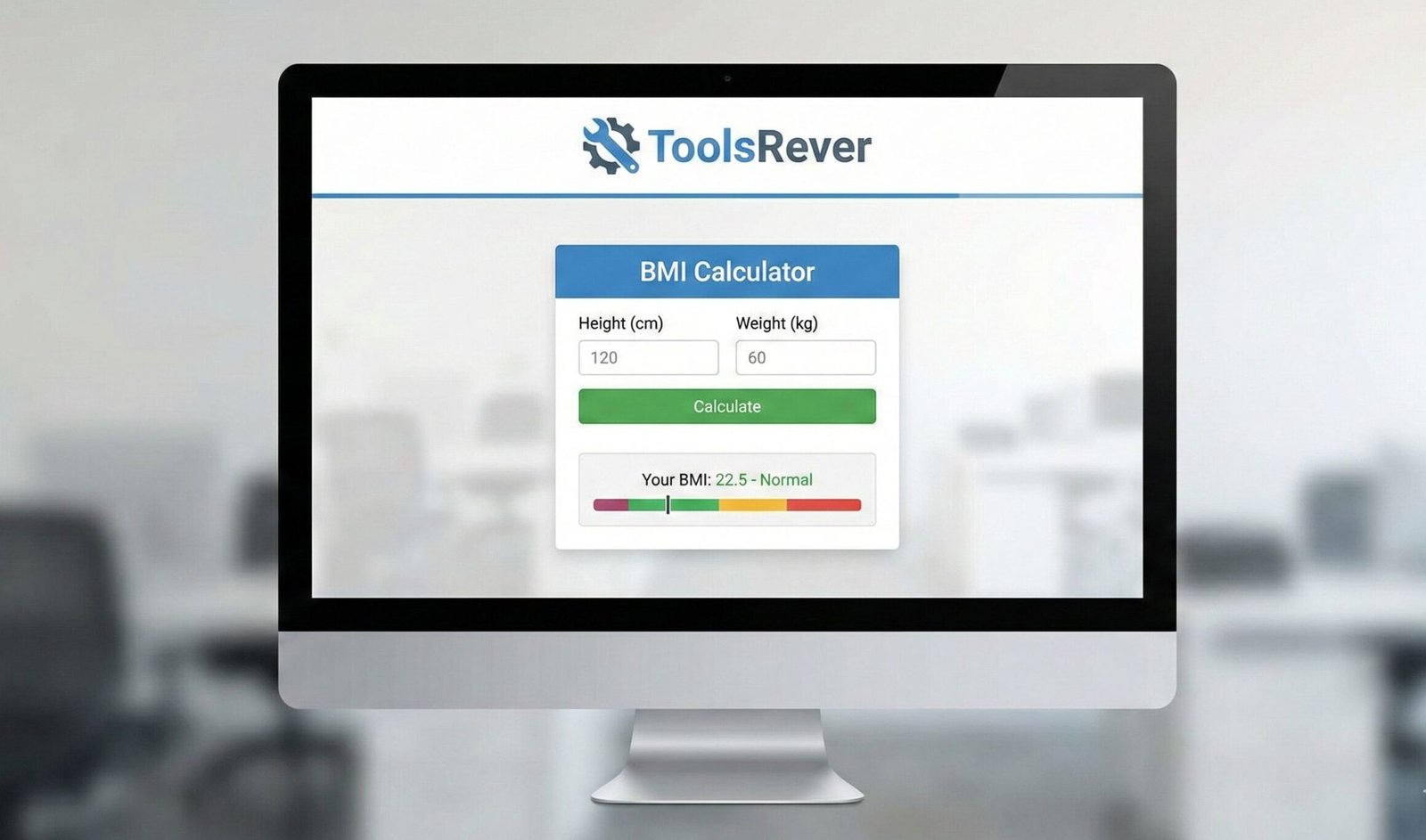
BMI Calculator
Calculate your Body Mass Index (BMI) to determine if you’re at a healthy weight. BMI is a measurement of body fat based on weight and height.
How to use: Select your preferred unit system, enter your height and weight, then click “Calculate BMI” to see your results and where you fall on the BMI scale.
| BMI Range | Category |
|---|---|
| Below 16 | Severe Thinness |
| 16 – 17 | Moderate Thinness |
| 17 – 18.5 | Mild Thinness |
| 18.5 – 25 | Normal |
| 25 – 30 | Overweight |
| 30 – 35 | Obese Class I |
| 35 – 40 | Obese Class II |
| Above 40 | Obese Class III |
BMI Calculator: Calculate Your Body Mass Index Online
Check your body mass index instantly! Our free BMI Calculator helps you understand your weight category and health risks. Get your results in seconds.
BMI Calculator: Understand Your Weight and Health in Seconds
Body Mass Index, or BMI, is one of the most widely used tools to quickly assess whether a person's weight is in a healthy range for their height. But what does your BMI Calculator score actually mean for your health? Are you in the underweight, healthy, overweight, or obese category? A BMI Calculator is a simple, efficient online tool that provides an immediate snapshot of your body composition based on a universally accepted formula. While not a diagnostic tool, it serves as a valuable starting point for conversations about weight-related health risks and overall wellness. Understanding your BMI Calculator can be the first step toward setting informed health goals and making positive lifestyle changes.
What is BMI Calculator and How is it Calculated?
BMI is a measure that uses your height and weight to work out if your weight is healthy. The formula was devised in the 1830s by Belgian mathematician Adolphe Quetelet and is now used globally as a standard screening tool by healthcare professionals.
The standard BMI formula is:
BMI = weight (kg) / height (m²)
For those who use imperial measurements (pounds and inches), the formula is adjusted to:
BMI = (weight (lbs) / height (inches)²) x 703
Our BMI Calculator automates this calculation, eliminating the need for manual math and ensuring an accurate result every time. You simply input your height and weight, and the tool does the rest.
Understanding Your BMI Calculator Results: What the Categories Mean
Once you calculate your BMI, the resulting number falls into one of several standard categories established by the World Health Organization (WHO) and other health bodies.
Underweight (BMI Calculator less than 18.5)
This indicates that a person may be underweight for their height. This can be a sign of malnutrition, underlying health conditions, or other issues. Being underweight can lead to problems like a weakened immune system, bone fragility, and anemia.
Healthy Weight (BMI Calculator between 18.5 and 24.9)
This range is generally associated with the lowest risk of weight-related health problems for most adults. It suggests a balance between height and weight. Maintaining a weight within this category is a common health goal.
Overweight (BMI Calculator between 25 and 29.9)
This indicates that a person is carrying excess weight for their height. Falling into this category increases the risk of developing conditions like type 2 diabetes, heart disease, and high blood pressure. It is often a critical point for making lifestyle interventions to prevent progression to obesity.
Obesity (BMI of 30 and above)
Obesity is a medical condition characterized by an excessive amount of body fat. It is subdivided into:
- Class 1 Obesity: BMI 30 to 34.9
- Class 2 Obesity: BMI 35 to 39.9
- Class 3 Obesity (Severe Obesity): BMI 40 and above
Obesity significantly increases the risk of serious diseases, including stroke, certain cancers, and sleep apnea.
How to Use Our BMI Calculator: A Step-by-Step Guide
Using our tool is straightforward and takes less than 30 seconds to get a result.
Step 1: Access the Tool
Navigate to our BMI Calculator.
Step 2: Choose Your Measurement System
Select whether you will be entering your measurements in the Metric system (kilograms and centimeters/meters) or the Imperial system (pounds and feet/inches).
Step 3: Enter Your Height
Input your height accurately. If using metric, you can often use centimeters or meters. If using imperial, you may need to enter feet and inches separately.
Step 4: Enter Your Weight
Input your current weight. For the most accurate result, try to weigh yourself at a consistent time of day, without heavy clothing.
Step 5: Calculate Your BMI Calculator
Click the "Calculate" button. The tool will instantly process your information and display your BMI score.
Step 6: Interpret Your Result
Your BMI number will be shown, along with its corresponding weight category (e.g., Healthy Weight). The result is often displayed on a color-coded chart for easy understanding.
The Limitations of BMI Calculator: What It Doesn't Tell You
While BMI is a useful screening tool, it is crucial to understand its limitations. It is not a comprehensive measure of overall health or body composition.
BMI Does Not Distinguish Between Muscle and Fat
This is the most significant limitation. Because muscle is denser and weighs more than fat, individuals with high muscle mass—such as athletes and bodybuilders—may have a BMI that categorizes them as "overweight" or even "obese," despite having very low body fat and being in excellent physical condition.
BMI Does Not Account for Fat Distribution
Research shows that where your body stores fat matters for your health. Visceral fat (stored around the abdomen) poses a greater health risk than subcutaneous fat (stored under the skin). Two people can have the same BMI, but if one carries more weight around their midsection, they may be at higher risk for heart disease and diabetes. Measures like waist-to-hip ratio can provide this additional context.
BMI May Be Less Accurate for Certain Groups
The standard BMI categories were developed primarily based on data from European populations. They may be less accurate for:
- Athletes: As mentioned, due to high muscle mass.
- The Elderly: Who may have lost muscle mass and carry more fat.
- Certain Ethnic Groups: For example, people of Asian descent may have higher health risks at a lower BMI, while people of Polynesian descent may be healthier at a higher BMI.
According to the Centers for Disease Control and Prevention (CDC), BMI should be used as a screening tool, not a diagnostic one. It's a good starting point, but a full health assessment requires more.
Beyond BMI: Other Important Health Metrics
To get a fuller picture of your health, consider these additional metrics alongside your BMI.
Waist Circumference
This is a simple and effective way to measure abdominal fat. A waist circumference of more than 40 inches (102 cm) for men and 35 inches (88 cm) for women is associated with increased health risks.
Waist-to-Hip Ratio (WHR)
This compares the circumference of your waist to that of your hips. It provides insight into your body's fat distribution pattern. A WHR of 0.90 or less for men and 0.85 or less for women is considered healthy.
Body Fat Percentage
This is a more direct measure of body composition. It tells you the exact proportion of your weight that comes from fat. Healthy body fat percentages vary by age and sex, but generally, for men, 10-20% is good, and for women, 18-28% is good.
Just as a BMI Calculator helps you understand your body's composition, ensuring your visual content is properly sized is key for a healthy website. For that, you can use our Image Resizer tool.
The Health Risks Associated with High and Low BMI
Understanding the potential consequences can be a powerful motivator for maintaining a healthy weight.
Health Risks of a High BMI (Overweight/Obesity)
Carrying excess body fat is linked to a wide range of conditions, including:
- Cardiovascular diseases (heart disease and stroke)
- Type 2 diabetes
- Certain cancers (endometrial, breast, colon)
- Sleep apnea and respiratory problems
- Osteoarthritis
- Fatty liver disease
Health Risks of a Low BMI (Underweight)
Being significantly underweight also carries health risks, such as:
- Malnutrition, vitamin deficiencies, and anemia
- Osteoporosis and bone fractures due to low bone density
- A weakened immune system, leading to frequent infections
- Fertility issues in women
- Increased risk of complications from surgery
What to Do After You Calculate Your BMI
Your BMI result is a data point, not a final verdict. Here’s how to use that information constructively.
If You're in the "Healthy Weight" Category
Focus on maintenance. Continue with the healthy habits that got you there, including a balanced diet and regular physical activity.
If You're in the "Overweight" or "Obese" Category
Don't be discouraged. See this as an opportunity to make positive changes.
- Set Small, Realistic Goals: Aim to lose 5-10% of your body weight initially, which can significantly improve health markers.
- Consult a Professional: Talk to your doctor or a registered dietitian for personalized advice.
- Focus on Lifestyle: Incorporate more whole foods, control portion sizes, and find a form of physical activity you enjoy.
If You're in the "Underweight" Category
- See a Doctor: Rule out any underlying medical conditions.
- Focus on Nutrient-Dense Foods: Aim to gain weight healthfully by eating foods rich in nutrients and healthy fats, not just empty calories.
- Strength Training: Building muscle through resistance exercises can help you gain healthy weight.
Frequently Asked Questions (FAQs)
Is BMI accurate for athletes and muscular individuals?
How often should I check my BMI?
Is the BMI scale the same for men and women?
Conclusion: Take the First Step Toward Health Awareness Today
Your BMI is a valuable screening tool that provides a quick, standardized snapshot of where your weight stands in relation to your height. While it has its limitations and should not be the sole indicator of your health, it serves as an excellent starting point for a broader conversation about your well-being. Using a BMI Calculator empowers you with knowledge, allowing you to make more informed decisions about your diet, exercise, and overall lifestyle.
Stop wondering about your weight category. Ready to get an instant snapshot of your health status? Use our free, easy, and accurate BMI Calculator tool now and take the first step on your journey to better health awareness!